

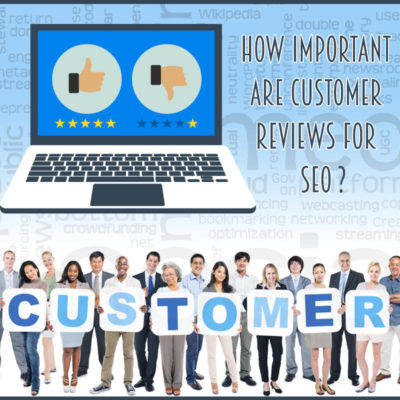
How Important Are Customer Reviews For Seo?

Why Customer Reviews Are Important for SEOIn order to have a happy life, you shouldn’t care that much about what people say about you. But when it comes to online businesses, this actually matters way more than you can imagine.

Besides trying to come up with new SEO ideas, in order to build some high-quality links and help your website rank well, you should also keep an eye on its day-to-day performance. Specifically, we’re talking about research, product development, sales fulfillment, or even customers service.

Forgetting about these aspects or even not caring about them that much can lead to a series of negative customer reviews, which can make you lose potential customers and even hinder your rankings.

Let’s take a few moments and understand how reviews can affect your SEO efforts, in both negative and positive ways.

They are actually user-generated content!

Just think about it: while you’re trying to integrate some specific keywords into your content, many of them feel very natural to the users who use them in reviews. And Google is seeing them as signals, therefore noticing your online presence.

Whether we’re talking about general keywords in your niche or long-tails, they are all necessary for your SEO strategy. Good reviews can take your ranking scores a bit higher, while negative reviews will bring you down if you are not careful.

They help you compete in your market!

Besides affecting your SERP rank, customer reviews can also affect your overall market performance.
Specifically, when somebody searches for a term in your niche, a list of results will be displayed. Some results have customer reviews, while some of them don’t.  Let’s take things logically: won’t you be tempted to check out the result with reviews, as It looks legit?

It was proven that people are more likely to trust an online business with a mix of reviews, whether they are positive or negative. By displaying these, a company shows that it’s far from being perfect, not to mention that it somehow guarantees that the reviews are real!

They provide a lot of value for local SEO campaigns!

When a user leaves a review, which contains local references, your local SEO efforts receive an unexpected boost. This review is a small piece of organic content, after all. The more you get, the stronger your presence will be in Google’s eyes.
The more positive customer reviews integrating local terms you’re competing for, the better for your business.

They help you establish a relationship with clients

When somebody wants to buy something online, Google offers the information about the product or service they are after, giving the best possible options available. As for customer reviews, these are real deal sealers.

Some people like to go through a couple of reviews before making the final decision, so it’s obvious that what past customers have to say matters a lot. Their opinion makes your business feel genuine and if the reviews are good, potential new clients want to feel the same thing.

Make sure you always answer the reviews, including negative ones, as you will help people know you better.

Keeping up with all reviews can be a bit overwhelming sometimes. If you want to build relationships with your clients, but also improve your presence in Google, SEO Jacksonville is here to help. Competitive search engine optimization packages, able to help you make a difference for your business, are just one call away, at (904) 425-9679.
Does Ranking At the Top On The Search Engines Still Important?

Most Important Ranking Factors, According to SEO Industry StudiesSEO refers to a collective set of activities that are inclined towards increasing rankings for a particular keyword or niche. Ranking at the top on the major search engines can help a business or a website to drive traffic to their websites and hence reach a large base of targeted audience.

Statistics indicate that a website ranking at the top receives 32.5% of search engine traffic, while the second and third position receives 17.6% and 11.4% respectively. Assuming that there is equal search traffic for every page, the first position on one page is equivalent to second positions on two pages and third positions on three pages. Thus, a website which ranks second can climb to the 1st position on a page as they can afford to let go of their second position. However, there has been a change in such views about SEO and at present they may not be as important as they were deemed before.
Following are some reasons why rankings may be losing their importance:

Advancements: Search engines like Google, Yahoo and others are constantly making progress in the field of analytics. They devise new ways to filter websites that post information on their pages ensuring that readers get nothing less than valid and authentic answers for their queries. Apart from ranking, Google also has a knowledge graph box that shows three websites answering a query in the most efficient manner. This may influence the readers to view these websites rather than blindly following the top ranking sites. It might reduce

Difficulty in finding keywords: Earlier, integrating most searched keywords or phrases were enough to generate traffic. Once a site achieved a certain rank, they could remain in the same position for a considerable time. However, with progress in semantic search, search engines no longer judge websites on the basis of the exact integration of the keywords or phrases in the content but on the basis of its relevance.

Content: Web developers and writers have realized that it is the content that matters the most with regard to optimization. If the content is written in a way that is easy to understand for the readers and is elaborate as well, leading to many links it will receive greater traffic. Moreover, content that is written in great details already has keywords and phrases that were used unintentionally. Hence, good content will always get precedence over forcible optimization.

Click through rates (CTR): The CTR is generally higher among top ranking sites. However, a site that is designed in a way that is meant to receive higher number of clicks by its users may become popular, irrespective of its position. This requires optimization of the site and appeal of the metadata to the users.

Time spent by the user: Ranking at the top or having great traffic either of these will hold value only if the user spends some time on the website. If majority of the incoming visitors end up bouncing before taking any meaningful action on the website, their presence would hardly matter. Even ranking for all the major keywords related to your website won’t be of any use in such a scenario. Hence, adding value to the content by allocating resources for achieving a balance between both value and quantity should be the key focus area.

However, the above points in no indicate that ranking at the top has no relevance today. It is still one of the most essential means to drive traffic but the concept of SEO has changed drastically over the years. There are more elements that contribute towards popularity of a business of a website now.

Local SEO Jacksonville Company offers advanced SEO facilities to clients from across the world. They can be reached by calling on 9044259679 or filling out the contact form at https://www.localseojacksonville.biz.

Guidelines on safeguarding your site from black hat SEO

Safeguarding from Risky Black Hat SEO TechniquesNegative SEO has been discussed animatedly and has been in the news of late. But what exactly is it? And to what extent does it prevail? Are there enough valid reasons to be worried about negative or black hat SEO? In case your website is broken into and hacked using negative SEO techniques, what steps can you take to restore your portal and preempt as well as prevent such malicious attacks in the future?
This blog takes you through the guidelines you have to follow in order to safeguard your site from the damaging aspects of a SEO strategy. But first let us familiarize you with the common features of a negative SEO campaign.

Defining Negative SEO

Negative SEO usually implies unscrupulous tactics that a hacker or an aggressive competitor of yours resorts to for bringing down your site’s ranking on SERPs or search engine results pages. Negative methods of search engine optimization also referred to as black hat SEO has to do with infiltrating and sabotaging a website by stationing innumerable spam links to the portal. Owing to the harmful impacts of such stratagems, the affected site’s ranking takes a beating and the site eventually loses quality traffic.
Instead of waiting for the hacker or the jealous competitor to bring down your portal, it’d be better on your part to thwart such spiteful attempts much before they cause heavy damage.

1. Keep Regular Watch On The Speed with Which Your Site Loads
The speed with which your portal loads on the browser is a significant ranking parameter. In case, the loading of your site is inordinately delayed on a regular basis, there is good reason to suspect that your site has become a victim of negative SEO. Thereafter, when you take the help of crawling software to detect what you have been suspicious of all along but cannot trace anything but your site loading is delayed, then you can be sure that your site has been.

If you are technically competent, you can weed out the culprits on your own or else you have to fall back on your web hosting service or the webmaster.

2. Carry out Link Audits Routinely
Carrying out link auditing frequently not only contributes towards improving the ranking of your site on Google’s or Yahoo’s SERPs (search engine results pages) but also helps in screening out links to unauthorized portals. If your site is linking to quality backlinks, the graphs and flow charts for ‘backlink progress’ and ‘linking domains’ will have a more or less smooth gradient. But if you espy a steep drop or spike in the slopes, then there is a good possibility that your site has been hacked into. Either conduct an audit manually or take advantage of auditing software app.

3. Weed out Negative Reviews
You could lose quality traffic due to a deluge of negative reviews loaded on your site by a malicious competitor. Find your business listing on Google Maps, select the listing, and click on review summary> reviews, flag the fake negative feedbacks, and complete the report form.

4. Be on the Lookout for Scraped Content
It could happen that your original content is lifted word by word by a hacker and posted on his or her site that gets reviewed by Google before yours. Use a Copyscape software to find out if your content has been plagiarized.

5. Keep a Tab on Click through Rate of Your Keywords
Review your keywords’ CTRs using Google Search Console and if you spot an inordinate spike, report the matter to Google and start disowning the bad links.

6. Keep Checking Your SERP Ranking Once in a While
Although this goes without saying, you need to check your SERP rank routinely just to make sure that your site’s ranking is at least maintained. Make the most of tracking software to check the site’s visibility across the net.

7. Ensure That Your Security Arrangements are updated periodically
Make sure that all your security arrangements are up to date. For instance, ensure that your site is stationed on a server that uses SSL encryption technology.

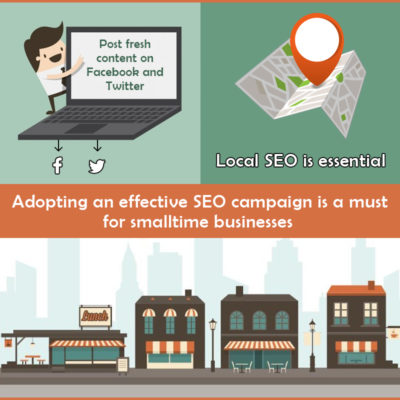
Adopting an effective SEO campaign is a must for smalltime businesses

Adopting an effective SEO campaignIn case you own and operate a proprietorship firm or have just established a startup, you might be very guarded and circumspect investing your scarce financial resources. So, you may consider allocating resources for small business SEO a dispensable and futile expense as you believe that SEO is not as effective as it used to be for promoting a firm or enterprise. Nevertheless, contrary to what you think, the significance of SEO is growing day by day vis-à-vis all the concomitant segments of trade and commerce.
Hitherto, SEO used to be indispensable for medium and large-scale outfits but with passage of time the online marketing strategy is proving to be equally vital for small and micro-sized businesses.

Defining SEO

Apparently, small business SEO may appear quite simplistic to you but in reality it can be remarkably complicated than you may envisage. SEO is not just about developing meaningful, original content, and keying in the relevant keywords but also about paying attention to other aspects that can be categorized under the heads of ‘on-page’ and ‘off-page’ optimizations. On-page optimization means taking steps for bettering your business portal’s ranking across SERPs of search engines like intuitive webpage design, fast loading times, and smooth navigation.

On the other hand, off-page optimization involves efforts to build quality links so that your e-commerce site becomes popular across the net and attracts a high volume of quality traffic. At the same time, implementing measures to bolster presence on automated social media platforms is also an off-page optimization endeavor.

Getting Started

It would be very imprudent on your part to completely disregard small business SEO simply owing to the technique’s complexity. You’d be investing much less on a search engine optimization plan for generating incoming traffic (read online leads) compared to your investments for engendering outbound or offline leads (through cold calling for instance). However, you’ll have to spare sufficient time for devising an intelligent and workable SEO campaign which you’ll have to find if you sincerely wish your business to grow and develop.

To say the least but not the last, once you get the hang of SEO, you’ll be in a position to take advantage of the following tips for improving your site’s position on the search engine results page of Google or Yahoo.

1. Local SEO-Though your business is much smaller than MNCs and big companies, you enjoy an edge over the latter as Google gives preference to local content. However, you need to have a clear idea about who comprises the local audience if you want Google to favor your business over the large corporations. You can make the most of the web-based tool, ‘Google Keyword Planner’ for punctuating local content with keywords running into many words or a long phrase.

Look for extensive phrases that capture the essence of your business, and create content revolving around such phrasal keywords. Most importantly, if you’ve more than one business address, ensure that the NAP is consistent for all locations throughout the web.

2. Link BuildingLink building is extremely crucial for augmenting the visibility of your site across all social media sites and other web-oriented platforms. Hire established bloggers to write quality guest posts, request your steadfast customers to write positive feedbacks about your product or service so that your site receives maximum publicity. Alternatively, steer clear of black hat methods and spamming techniques if you want to avoid getting penalized by Google.

3. Social Media-Automated social media can go a long way in driving more traffic towards your site. Therefore make sure that you routinely post fresh content on Facebook and Twitter.

In order to tap the aforementioned small business SEO to the optimum, you can log in at www.localseojacksonville.biz or make a call to 904.425.9679.

Making the most of organic SEO and local SEO for your online business

Organic SEO and local SEO for your online businessIrrespective of whether you’re push selling a product or aggressively promoting a service via your web-based or online platform, the effectiveness of your SEO strategy will decide whether your site is there on Google’s or Yahoo’s first SERP. You may be aware that nearly 90% of all users never bother to look beyond the opening search engine results page when looking for a product or service or searching for specific info? So, you might be tempted to ask yourself as to how you can make your e-commerce site claim a 1st page rank on Google, especially after all your previous attempts to do so have come a cropper?

The answer to the aforementioned question largely depends on whether you want your portal to rank for local SEO or organic SEO. There’s a great deal of difference between the two expressions and there are specific factors or attributes based on which organic search engine optimization can be differentiated from local SEO. This article elucidates on the fundamentals of both online marketing strategies, and after going through both, you’ll have a fair idea on where and how to channelize your efforts for driving maximum traffic to your site.

Demystifying local SEO

  • What is local SEO?- When you plan your campaign for promoting your business throughout the world of web based on where you are physically located, such an approach is termed local SEO.
  • Who stands to benefit the most from local SEO?-If you’ve have a brick-and-mortar outlet, physical consultant office or a medical chamber, you’ll stand to gain maximum by fine-tuning your canvassing strategy for local search. In that manner, prospective customers situated in the vicinity of your physical storefront will be able to locate your store or chamber, thereby boosting your business.
  • Modus operandi of local SEO-Consider a hypothetical scenario where you go online and browse for a standard family restaurant in the area where you reside. You’ll most probably search on the Google or Chrome browser using the keywords, ‘best family restaurant in Piccadilly’, family restaurants in Piccadilly’ or ‘restaurants for dining with family in Piccadilly’, and so on. After keying in the keywords, and clicking ‘enter’, you’ll instantly see Google throw up the search results.
  • What you actually see is the first page of the results. The URL at the top of this page is the one that is maximally optimized for searching locally. The URLs that follow are ranked in order of their optimization level. The restaurant heading the list is the one that’d be most convenient for you to step in.

Tips on making the most of local SEO

  • Ascertain your NAP consistency-No ‘NAP’ is not an abstract term but the abbreviation simply stands for name, address, and phone number. When you host your site, ensure that your business’s name, address, and phone no. is identical throughout the internet and across all directories.
  • Take advantage of Google My Business tool-For ranking high enough on local SEO search listings, tap the potential of Google My Business tool for listing as much info about your venture as you can.
  • Persuade customers to post positive feedbacks about your business
  • Always use relevant keywords that will let your customers find you quickly

About organic SEO

  • Defining organic SEO-When Google ranks your website (using search algorithms) based on your site’s content and user-friendliness, the process is called organic SEO.
  • For whom organic SEO is meant?-Organic SEO strategy works best for businesses and firms that only have an online presence and do not own a physical office or branch.
  • Mode of operation of organic SEO-Extrapolating the abovementioned example of ‘family restaurant’, the chances of your restaurant showing up in most organic search results will be higher if you temper content with relevant organic keywords that have a greater likelihood of being used by diners.

Guidelines for taking advantage of organic SEO

  • Keyword optimization is the key
  • Adjust and tweak on-page optimization
  • Garner as many quality inbound links as you can
  • Develop content around a focus keyword

https://www.localseojacksonville.biz will help you out with formulating a customized local or organic SEO strategy for you. You can also make a call to 904.425.9679 for clarifications.

9 Effective Tips for Promoting Your E-Commerce Outlet

9 Effective Tips for Promoting Your E-Commerce OutletYou’ve an e-commerce store that you wish to promote in the best manner possible in order to reach out to the maximum number of potential customers. You have taken all the necessary measures to make your online outlet optimized for e-commerce SEO. You may have already done all the homework for making the site friendly for Google’s web crawlers, including indexing the web pages, readying it for downloading quickly across digital handheld and desktop devices, and so on.
Now, in order to increase the flow of traffic to your e-commerce portal, you can make the most of the following e-commerce SEO techniques.

  1. Upload relevant and creative content about your product or service

Regardless of whether it is a product or service that you wish to promote, the best way to do so is to present the benefits and features of the same via creative and engaging content. Writing at length is perfectly all right as long as you are not beating about the bush. Not making the content keyword heavy is another aspect that you need to keep in mind.

  1. Have title tags that will titillate users to click on the same

Having an appealing title tag that will titillate the users to click on it is another useful e-commerce SEO   tip to bear in mind. Most of the time, you are so focused on the bigger picture in order to ameliorate your site’s search engine ranking that you tend to miss out on the seemingly inconsequential aspects.
For instance, a plain and simple title tag may not induce users to click on it as much as a catchy one.

  1. Go for versus posts

You can try the versus post strategy in case you are promoting two of the best selling products under a product category from your online store. In other words, you could create a post or blog comparing and contrasting the two products or write a piece where you review the products vis-à-vis other comparable products.

  1. Encourage bloggers to review your product

This is a tried and tested strategy but remains effective to this day. Look for bloggers who focus in your area and have them write reviews by offering them a free sample.

  1. Prefix or suffix the words ‘buy online’ to the title tag on the product page

Prefixing the words “buy online” or even suffixing the same to the title tag of products goes a long way in boosting meaningful traffic to your site. The probability of someone clicking on the product title tag is higher when you add those words.

  1. Write articles that serve as buyers’ guide

This e-commerce SEO tip is helpful for those who deal with a wide range of products of different brands. For instance, if you are selling salmon fishing hooks and related accessories, you could pick and choose from several keywords, germane for the items, like ‘different kinds of salmon hooks’ or ‘the best salmon fishing lines’.

  1. Take advantage of Schema Markup for positively reviewing product

If you wish to attract higher traffic from your current SERP position, you can take advantage of Schema markup for annexing reviews to every product page.

  1. Make the most of promotions

Devise a good promotional offer and publicize the same across all online platforms in order to make your product ubiquitous.

  1. Canvass newly launched products via reviews

SEO Jacksonville Company can help you out with your e-commerce platform promotion. Contact the firm at 904-425-9679 or log in at www.localseojacksonville.biz

How to Gain Local SEO Clients

How to Gain Local SEO ClientsProviding search engine optimization (SEO) services locally can be a very lucrative and rewarding job, but gaining new clients can also be quite a challenge, especially as you are just starting up. This is especially true when you are cold calling or walking into businesses blindly hoping to get their business. The first thing here is often an education component that you need to provide- you really need to create that value proposition for your business and your services and sell it in terms of why it is good for THEIR business or company.

There are often great information asymmetries and you will often find that potential clients have very little to no understanding of the web and how search engines actually work. Coupled with this, they may also not completely grasp the power of ranking well and getting organic traffic to their website. These are points for which you should really try to fill the evidence gaps. Usually, they will have only heard buzzwords if anything and you have to make sure that they understand realistically what can be and should be done

Your pitch is everything once you have your foot in the door. Practice it a hundred times and practice it again because it can literally make or break your business. A strong pitch can make even the ficklest of clients open-minded and open to your ideas.

The first thing that you need to master are the facts. If you do not know what you are talking about it will be clear as day. You have to have a smooth pitch in which you show confidence and understanding. Filler words like “um” and “like” have the opposite impact so you need to practice avoiding them. Furthermore, you should have an evidence-based presentation with data to back up any claims you make. You should also do some scenario planning for potential questions you might get and be prepared to answer those with any data you may have. Facts matter and people recognize that.

Beyond being confident and understanding the space (including competition, needs, gaps, etc.), it is important that you understand the particular client you are going to speak to. Now you will never have all of their information from the get-go, but you should do you due diligence and try to estimate what their needs are to the best of your abilities. Once you start your discussions, do not be afraid to ask for more information or ask if your assumptions about their business are correct. The more relevant and focused the presentation is to their business, the more effective it can be. To do your background before you go in, use tools like MozLocal Listing, SEMrush, and other local listing vendors to see how your potential client currently fares and who their major competition might be. From there try to cater a presentation which hits on the primary points of your findings and helps them improve relative to their competition. Local SEO can be a tough sell, but once you show that you can help them gain customers over their competition, they will be on board.

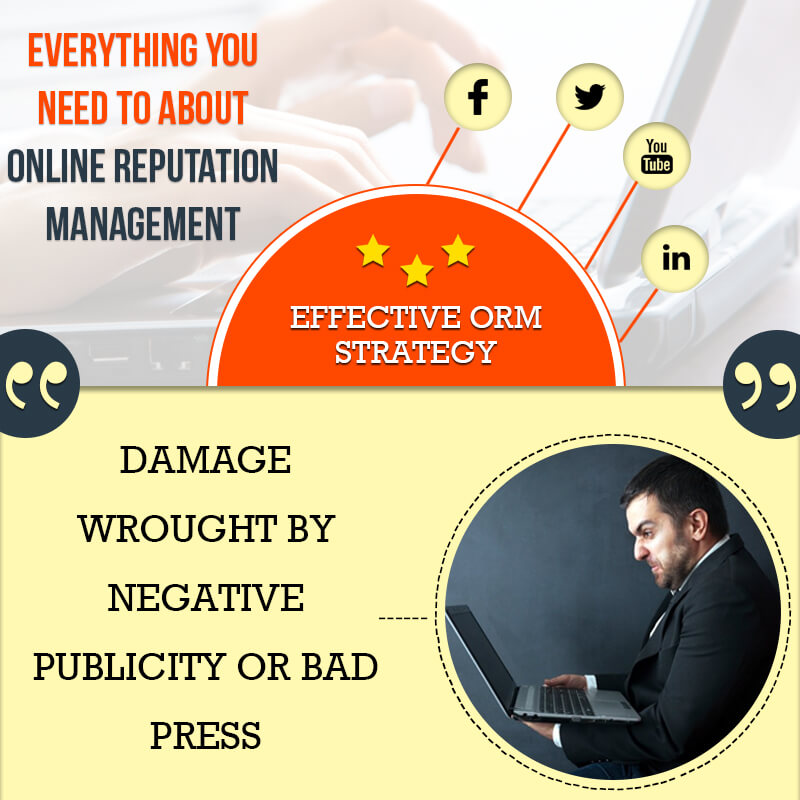
Everything You Need to About Online Reputation Management

Everything You Need to About Online Reputation ManagementOnline reputation management is an effective remedial or corrective technique that businesses, both big and small, take advantage of in order to brush their images (tarnished by the bad press) on search engine’s SERPS. ORM as a quick fix for tackling negative publicity on the web can be smoothly integrated with your company’s SEM or SEO strategy. Negative or destructive feedbacks, comments, and blogs (and sometimes entire sites) about a product or service posted by anonymous complainants/users on automated social networking sites brings down it is ranking on Google.
Damage wrought by negative publicity or bad press

Grievances voiced by users of a brand (looking for a shallow alibi to vent their complaint) on Facebook or Twitter have the potential of going viral, eventually besmirching the manufacturer’s or service provider’s online reputation. The cloak of anonymity offered by social networking sites encourages and emboldens subscribers to air their accusations regarding a brand which can reduce the firm’s or entrepreneur’s earnings. Those posting malicious or off-putting comments rarely reveal their actual names or addresses rendering it next to impossible for the affected firm to trace the source and address the grievance.

If you or your company has been victimized by bad publicity, you’re the ideal candidate to opt for an online reputation management damage-control exercise. But before you do, you should apprise yourself of the extent of the undesirable impact that negative publicity or bad press can have on your or your brand’s online status.

ORM: Striking before it starts to hurt

When it comes to getting an online reputation management action plan underway, most companies adopt a reactive strategy. By the time the ORM campaign starts delivering, a considerable damage has already been done as the highly ranked sites or web pages act as breeding grounds for inbound links. Muffling the top ranking pages littered with unconstructive comments becomes all the more difficult as the inbound links further reinforce the ratings of the pages.

On the other hand, an ORM promotion that takes a preemptive and proactive approach is highly successful in thwarting bad press from gaining ground and becoming viral. Such a hands-on ORM strategy is devised in a manner that it is extremely effective in monitoring the top-ranked organic standings. A constructive ORM plan should be able to preempt negative publicity and shield the company from the damaging feedbacks of perverted customers and frustrated employees.

Stemming bad press with ORM

Popular search engines including Google, Bing, and Yahoo index and rank web pages or sites based on specific SEO algorithms.  Individuals who’re well versed in creating negative remarks are aware that posting the comments or blogs on high-ranking blogs will publicize the same across the social networking platforms. As a result, when or whenever anybody browsers on the net to find out details about your business, they’ll mostly see links badmouthing your firm. Reverse SEO is an excellent online reputation management technique that can help you obliterate the negative publicity placed on the top URLs in the first SERP.

What is an effective ORM strategy comprised of?

Online reputation management, very much like SEO exploits a multi-faceted strategy so as to safeguard your company’s reputation across the web. An effectual ORM plan first targets exactly those web pages or sites where the maximum bad press regarding your firm is abounding. In the next stage, these websites and pages are scrutinized based on their ranking status.

Once you’re aware of the ranking parameters that these sites have exploited to clamber to the top, you’ll be in a position to use the appropriate tools and/or techniques to remove the links from the sites. In the third and final step, you’ll be taking advantage of the relevant tools such as profiles on social media, bookmarking programs, PRs, and a bevy of newly launched blogs or sites.               

The Best Ways to Choose The Right Set of SEO Tools for Your Business

The Best Ways to Choose The Right Set of SEO Tools for Your BusinessOver the past couple of years, the rules of the SEO has changed drastically. This has especially been a revolution when it comes to small businesses. With increased awareness and the relevance of quality content, small businesses have been rapidly investing in content. However, besides the quality, you need to make sure that it is backed by the right set of SEO tools and strategies. The old thumb rule when it came to SEO was quite simple,stuff as many keywords you can to rank on the search engines. But with Google changing the way it ranks websites, there has been a rapid change.

To succeed and remain safe, it is important that you use the right set of tools. There are a number of tools that can be used today. Many of them are free and can help small businesses to manage and navigate their SEO strategies to the optimum levels. Some tips that can help you select from the available tools have been discussed below:

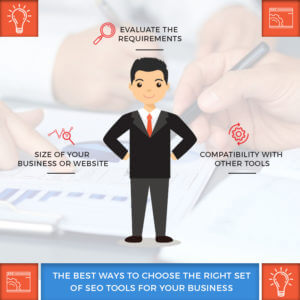
  • Evaluate the requirements: The internet has an enormous number of options to choose from. However, not all might be something that would help you with your problems. For someone who is looking to get the basics right, it would not be advised to invest in a heavily loaded and feature rich software. For instance, if you merely need something that is capable of doing a keyword research, a free basic tool can do the job quite easily. However, if the requirement is to go deeper, then a paid option is something you need to go for. This may include the discovery of long tail keywords, link building, guest posting and more.
  • The Size of your business or website: For a large business you definitely have a team of people who manage different aspects of SEO. If this is your case, you need a comprehensive SEO tool that performs complex tasks and makes the management a lot easier. Moreover, besides the team size, the other thing to consider would be the scope of the website too. In case you have a website with thousands of pages, then a high-end SEO tool is what you need. On the contrary, if you are a small business and want to make things simpler to rank well for your products and services, simple tools with scalability options is the one to go for.
  • Compatibility with other tools: The moment you are about to choose an SEO tool, the most important thing to look for would be its compatibility with the other set of tools you have been using. Besides being simple, the tool needs to have the capability to work well with your website and the other marketing tools that you had been using before. For instance, most of the people who have a website running on WordPress prefer using The plugin is advanced and is well compatible with the platform.

The yesteryear strategies are now getting heavily penalized by all the major search engines. The changes have been for the better and one can expect it to be a lot better in the coming few years. However, if you had been using the recommended tools and white hat SEO techniques over the years, this is not something that you should be worried about. The year 2016 saw a number of small and big changes to Google’s algorithm. Starting from the importance of a mobile-friendly website to the value of the web pages, the changes have definitely turned the tables for small businesses.


Latest Processes in SEO This Year

Every site requires a good optimization process to perform well. The webmaster should take the service of an SEO firm that is well aware of some of the best and latest updates and has been successful in utilizing the latest resources of the internet. Some of new aspects that you should know are discussed to help you get good rankings for your site. One of the most important thing that you should adopt in the current year 2013 is the social media process. If you take the help of new social media, especially Google+ then one’s site will surely get good visitors and you can expect to earn well. Google plus is connected with one of the best search engines in the world and it all the posts are shared here then the website will automatically rank well.

Another aspect is to make any site easily navigable and make it friendly for the mobile users. Around 16% of search comes from different mobile devices and this is huge. Taking advantage of this opportunity will help you get users from different parts of the world and increase the traffic. Along with this you can try to mix the PR options properly with your SEO techniques. It is always important to make the site as simple as possible and as the visitors like to navigate through the sites that are easy to view. Simple SEO techniques will no longer help your site. There are many updates that you would need to adopt to make it big in the current year 2013.