


GMB Profiles: Tips and Tricks to Land on Page One With Your Law Firm

GMB Profiles: Tips and Tricks to Land on Page One With Your Law FirmLaw firm SEO is essential when your goal is to land on page one. And with your GMB (Google My Business) profile, you have a better chance of showing up on this page and being featured with not only a link to your website but also reviews and contact information.

In this article, we will discuss the top tips and tricks to land on page one with your law firm SEO strategies using your GMB profile.

There are many tricks and tips for attorney SEO that can help a law firm website land a page one spot just using the information submitted from their Google My Business profile. Consider using any one of these tips and tricks to assist with your law firm SEO strategies.

1. Get specific about your law firm. If you are a law firm that specializes in workman’s compensation, list Workman’s Comp lawyer or something similar to this. If you are a divorce attorney, list divorce attorney. Never list just a lawyer or attorney. Some will argue that they will not show up in as many searches. While that is true, know that you will rank higher when you specialize in a niche.

2. Obtain reviews from previous clients that were impressed or satisfied with your services. Think about yourself when looking at different products or services. Do you look at the reviews of what others have written? Or do you just go with the first service/product you find? Most of us will read reviews, so make sure you have plenty of these on your GMB profile. As an added benefit to these reviews, your GBM profile could see an increase in the SERPS, as Google is a huge fan of reviews.

3. In order to land on page one, you may consider using link building. Link building is a great tip of law firm SEO as Google can check how prominent you are- how well known you are online, as well as how valuable your firm is to those that are performing searches. This is where backlinking comes into place. When you have many backlinks, your site is more trusted by Google, as well as very prominent.

4. A great attorney SEO tip is to make sure you have completed your profile on your GMB. It is advised to have at least 50 images. If you are having trouble with this number, you need to at least have more images then your competition. Make sure that all names are accurate and correct, and use a video on your profile. You should also write a full business description and service description. This will also help you to optimize your business profile. Be sure to add in keywords that will be helpful when potential customers search law firms.

5. Remove duplicate content. If you have a few locations for your law firm, make sure that each location is only associated with one GMB profile. If a location has already been associated with another GMB, it will not appear on Google maps. If you do have a duplicate listing, it is easy to remove. Always remember to prioritize the listing that you want to be associated with your Google My Business account.

You can use your GMB listing to help your law firm land on page one of the SERPS. Remember for the best attorney SEO, you want to be as specific as you can about what type of lawyers your firm has. Always make sure you have plenty of reviews and have link building done. Your GMB profile should be filled out completely, and all duplicate content will need to be removed.
If you are not able to do this yourself for your law firm, consider hiring Local SEO Company for all your law firm SEO needs.
What Is Local SEO And Why It’s Mandatory In 2019

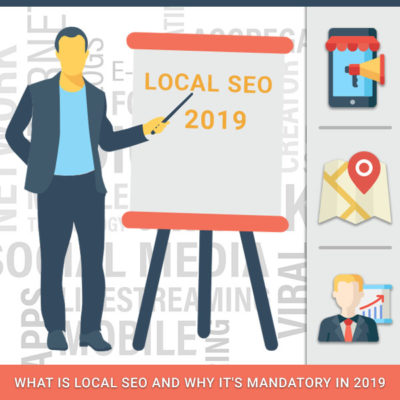
SEO Jacksonville - What Is Local SEO And Why It's Mandatory In 2019In a nutshell, local SEO is a branch of search engine optimization that focuses on optimizing a website in such a way that it’s easier to be found in local search results. You can also call it a process emphasizing the optimization efforts of local brick-and-mortar businesses, instead of just online businesses.

Unfortunately still ignored by many business owners, local SEO is essential nowadays, considering that most searches made on Google are now made using a mobile device. Besides this, stats confirm that half of the people who did a local search on their phone actually went to the physical store they needed information about within one day, while a staggering 97 percent of consumers searched online for a local business in 2017.

Looks like “x business near me” is one of the most powerful search queries of the moment.

Who needs local SEO?

There are several categories of clients who can make great use of local SEO, among them being lawyers and law firms, doctors and medical practices, as well as plumbers. Basically, the types of services you need in case of an emergency.

Then, there are restaurants. This type of business achieves a lot from local SEO, as a potential customer can immediately check reviews from other clients, see the opening hours and address, then leads them to the business in the least amount of time.

Ok, but is it for everybody?

No, not at all. The reality is that some types of businesses just don’t need local SEO. E-commerce shops, authors, or any other business that doesn’t share local information are definitely not good candidates for some local SEO services.

How is local SEO done?

At first, it might look difficult, but the truth is that local SEO is not that different from organic SEO, since it also implies keyword research, creating quality content, obtaining links and, obviously, taking care of on-page SEO. Basically, the main difference is that it just has a local focus.

All of the above-mentioned elements are essential for a local website, in order to outperform the competition in SERPs. And when it comes to optimizing for the so-called ‘near me search’, you need to do them with the local customer in mind.

We’re talking about using keyword variations that have a conversational tone and focus, able to achieve huge search volumes, creating content with a local focus, and, obviously, get some high-quality links, from – for example – NAP sites, local directory websites, industry-related local sites or even local newspaper sites.

Again, the core idea is the same to organic SEO, but this time, you’re optimizing just for users in a specific area. And your mission is to help them find the business they need, preferably one as close as possible to them.

Do I need local SEO?

If you have a local business and want to attract as many clients as possible, yes, you absolutely need it. Sure, you can also live without this as well, but why miss on such a great opportunity?

Gone are the days when people were searching for local businesses from desktop devices. Everybody as a smartphone with Internet access and whenever they need a local service, they’re a few screen taps away from finding it. And stats claim that they end up going to that location within the next hour. Let that sink in for a moment.

So, are you looking forward to starting using local SEO for your brick-and-mortar business? If the answer is positive, start with a competitive SEO package, able to satisfy any business owner and deliver results. SEO Jacksonville has exactly what you need, promising to deliver results-based work, so your business can be taken to the next level.

Picture Credit: flaticon.com

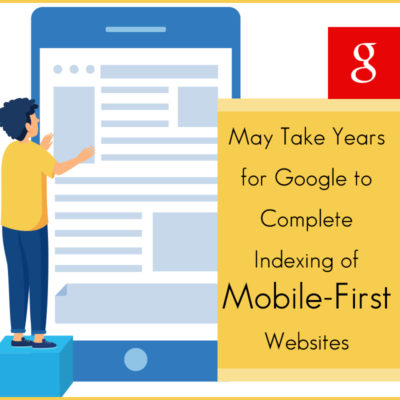
May Take Years for Google to Complete Indexing of Mobile-First Websites

Google begins to roll out mobile-first indexingIt is now more than a year when Google made it public that the search engine was about to introduce a strategic change in the manner it ranked websites. The change would mean that the search engine’s algorithms, in the long run, would first consider a website’s content created exclusively for a smartphone, for assigning a SEO rank to the site. At the same time, Google would first and foremost use the site’s mobile adaptation for displaying snatches or clips about the site in the SERPs and also for analyzing structured data.

The world’s most popular search engine announced quite a long time ago that the process of shifting the sites from desktop-first indexing to Google mobile-first cataloguing was already underway. In fact, a significant proportion of the sites had already been transferred to the mobile-first register. Webmasters, web designers and developers, and SEO specialists have been expectantly waiting for the first roll out to become available.

Google’s engineers had expressed that the launch would have happened at the close of 2017. But as things stand now, it seems that the roll out might become a reality by the end of 2018.

Demystifying Google mobile-first indexing

The connotation or meaning of Google mobile-first is quite straightforward. It simply means that when or whenever the search engine embarks on a SEO drive, it will accord primacy to your site’s mobile edition. In other words, it is the smartphone transcript of a site that Google will first take up for ranking. You could see an upsurge in traffic (facilitated by smartphone Googlebot) when you analyze traffic directing to your site.

Also, the cached copies of the web pages that are visible will normally be the pages’ mobile variations. Mobile-first does not just imply that the indexing is compatible only for smartphones-if you’re yet to create a smartphone-friendly version, the index will continue to rank your desktop adaptation. Nevertheless, you should not lose sight of the fact that your site’s ranking could take a beating in the absence of a smartphone-compliant version.

On the other hand, sites with mobile-friendly editions will rank better even when Google ranks desktop-first (indexed) websites.

Migration of sites from desktop-first indexing to mobile-first indexing far from complete

Google Webmaster trends analyst, Gary Illyes had remarked in June 2018 that was “probably many quarters away” from making available its mobile-first directory. He also added that the change (the changeover from desktop first to mobile first) would be ground-breaking and there was absolutely no reason to feel alarmed about the transition. Webmasters were anxious to hear from Gary about the exact launch date but he was unable to specify the same.

Illyes, at the same time, made it amply clear that the search engine was also working on releasing the index in a manner so as to not adversely impact sites that were yet to become mobile-ready. And it is for this reason the launch was getting rescheduled time and again. He also mentioned that Google wanted to be doubly sure that the sites categorized in the mobile-first catalogue would not negatively impact non-smartphone-friendly websites.

Evidently enough, the roll out could take a long time-in fact it won’t be due before 5 years. He expressed that Google was willing to discuss at length with the publishers regarding the launch, instead of keeping them in the dark about it. He made it clear that the Google mobile-first roll will not come in the way of ranking desktop-centric sites.

Gary said “Mobile-first means mobile first. It only means that we’ll look for mobile content first”. On your end, you should see to it that your site’s design and content is companionable with smartphones, tabs, and all other types of handheld digital gadgets so that you’re not caught unawares when it actually happens.

You can know more about Google’s mobile-first index at www.localseojacksonville.biz.

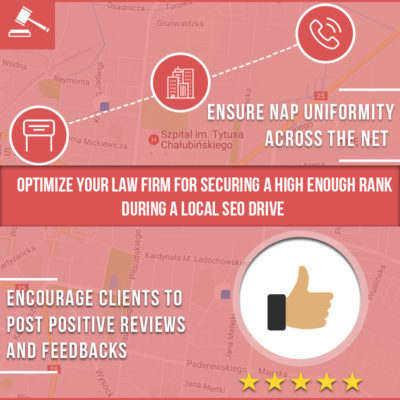
Optimize Your Law Firm For Securing a High Enough Rank During a Local SEO Drive

SEO for Lawyers: Ways to High Enough Rank During a Local SEOFormulating and implementing a robust local SEO tactic will go a long way in directing relevant traffic to your legal consultant website as well as boost your brand’s position across the web. To put it precisely, if you implement your law SEO strategy, your site has a greater likelihood of figuring at the top of search engine results pages both during paid searches and organic searches. As your SEO for law firm gathers pace, you’ll be getting the results you’ve been eagerly waiting for-increased citations, more positive feedbacks, and quality backlinks.

Abide by these tips for boosting up the effectiveness of your local SEO strategy which in turn will enable you to attract prospective clients and thereby cement the goodwill of your legal consultancy or practice.

1. Create your regional profile

In order to give your law portal a head start, claim a ‘Google My Business page’ listing. Once your site is listed on Google My Business, your chances of being found by potential clients will go up manifold. As a matter of fact, you can create a listing for all popular search engines, apart from Google, like Bing and Yahoo.

The more listings you have across the web, the greater are the chances of your site being checked out by the niche segment. In case, you’ve more than one office or business address, then create a separate webpage for each and every location. For adding more teeth to your law SEO strategy ensure that the name, address, and phone numbers for every office or branch is same throughout all the directory sites, social media platforms, and all other online outlets

2. Ensure NAP uniformity across the net

As mentioned above, if you want your SEO for law firm line of attack to deliver the desired results, you should first and foremost ensure that your establishment’s physical address, name, and contact number or numbers are identical all throughout the Internet. Never ever key in a PO Box number to serve as the address and also do not list a toll-free number. Just to cite an instance, if your practice is registered as ‘Kramer & Calvin Law Firm’ in one location, ascertain it is listed under the same name, word by word, in all other localities.

Bear in mind that even a slight change in the listed name in terms of spelling, ordering of words, punctuation, and other details would dent your firm’s goodwill and standing in the eyes of Google. At the outset, such inconsistencies might seem trivial but when it comes to local SEO, you should see to it that such discrepancies never creep in.

3. Make sure content is relevant for local SEO

Create, post, and keep updating content that incorporates local aspects and elements impinging on your business, both directly and indirectly. The content should clearly mirror the nitty-gritty of your practice and the services you offer to your patrons. At the same time, ascertain that the content is original and sufficiently engaging to arrest the attention of those who log in at your site. Also, upload blogs and articles which highlight your active participation in social and cultural events organized locally.
You’re more likely to net more customers if you can spread the word that you’re a socially responsible individual apart from a hardcore professional.

4. Encourage clients to post positive reviews and feedbacks

Encourage your steadfast clients to voice their opinion about your firm-tell them to review your firm positively without of course exaggerating. Inspire them to write about the experiences they had while they were represented and served you.

5. Transparency matters the most

That you should be honest and transparent in your business dealings holds not only your legal practice but for any and every type of trade or profession. Offer clear cut information about your practice in the website, do not misuse or overuse keywords, and mention the correct postal address so that your potential clients can get in touch with you in person.

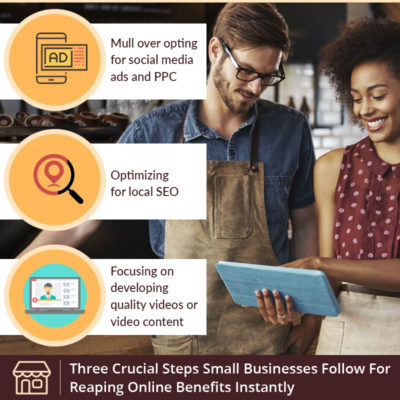
Three Crucial Steps Small businesses Follow for Reaping Online Benefits Instantly

3 Crucial Steps How Continuous Improvement Can Benefit Your BusinessThough small businesses spare no efforts in bolstering their online presence, they often do not have access to resources and tools that are available to behemoths and conglomerates. Talking about online presence or existence, it chiefly comprises your company site, business listings on social media platforms, and business listings of key stakeholders. Nowadays, majority of your customers and prospects are most likely to search for your site on their smartphones-so it is crucial that your portal’s URL is visible when someone browses with a particular set of keywords.

If you’ve a startup or small business to promote, planning an appropriate online marketing strategy could seem to be a daunting task. However, laying out an effective modus operandi for giving teeth to your SEO plan will surely make the mission of publicizing your site across the web somewhat easier. This post walks you through three simple yet practical steps for guaranteeing online success.

1. Mull over opting for social media ads and PPC

Facebook continues to be the top social media platform, having the highest number of users and followers amongst all other automated social media sites. Hence, the alterations effected by Facebook of late have created some online marketing impediments. However, this is not a recent phenomenon as such modifications have been carried out in the past leading to social media promotion upheavals.

Users’ feeds on Facebook that mostly used to be organic in nature, have now transformed into paid content. That in essence, implies you’ve to pay for advertising (read promotion) on Facebook so that you can view others posts and blogs. The same ruling applies for other users as well.

Paid advertisements enable you to target and tap your niche segment as well as contacts of your customers. Consider opting for PPC (pay per click) along with SEO for placing your blog posts in front of target segment. PPC ads give your business the leeway to temper content with target-oriented keywords. The results of your online marketing efforts will be at your disposal almost immediately.

At the same time, you’ll have the added benefit of reviewing the analytics with a view to fine-tuning your efforts. Additionally, you can take advantage of geotargeting when it comes to targeting relevant prospects. To put it succinctly, PPC is a very efficient way of gauging the marketing potential of your site as well as the efficacy of your canvassing strategy on the whole.

2. Optimizing for local SEO

One of the most effective ways of popularizing your small firm on the web is by marketing the business locally. It does not need to be emphasized that in order for your business to grow and develop, you have to take steps for making it familiar locally. Putting it in perspective, you’ve to forge an online marketing plan that’ll propel your site to the top of the first SERP whenever Google embarks on a local SEO drive.

To buttress local SEO optimization, you can register your site with/on Google My Business. Also, list your site with local Chamber of Commerce and other popular search engines like Bing, Yahoo, and MSN. It is extremely crucial that the name, address, and phone numbers of your entity is consistent throughout the web.

3. Focusing on developing quality videos or video content

There’s no gainsaying the fact that the bulk of your customers and prospects will form an opinion about your establishment after watching YouTube videos. Make sure you design high-quality videos that’ll supplement content of your site. Nowadays, producing videos about your product or service has become a simple affair, thanks to state-of-the-art tools that even a layperson can use effectively.

For more tips and suggestions on how you can promote your business online, log in to www.localseojacksonville.biz or make a call to 904-425-9679.

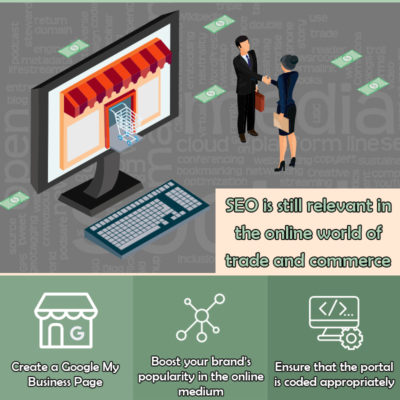
Seo Is Still Relevant In The Online World Of Trade And Commerce

Is SEO Really That Important for E-commerceOnline marketers and social media promoters who’ve already cast aside SEO as passé and antediluvian, would be pleasantly surprised to know that search engine optimization is more germane than it ever was. Simply put, local SEO plays a key role in helping major search engines like Google, Bing, and Yahoo as well as net surfers track down your business website. At the same time, it does not need to be emphasized that in the present times, almost 80% of prospective customers go online for viewing and/or reviewing products and services before purchasing.
The upshot of the above assertion is that it still makes sense to optimize or sync your site with the search engines so that the portal gets a rank almost on the top of SERPs. Vice President of marketing at Boostability, Kelly Shelton also shares the opinion that local SEO can prove instrumental in enabling your business to claim a listing on Google’s first SERP. According to Kelly, almost one and all browse on Google when they wish to find answers to a question or search for a product.

And Google’s search algorithms always deliver. No wonder why Google is the world’s most popular search engine. Google makes use of a string of parameters for according a rank to a business site including but not limited to website design, textual/visual content quality, page load speed, and navigability. It is quite shocking to note that though most of the consumers nowadays browse on the net before buying something, there are still a good number of businesses that do not even have a website.

A good proportion of those running small businesses are hamstrung by misgivings and mistaken notions about the Internet. Many businesspersons strongly feel that they’re small fries compared to the ecommerce behemoths like Amazon, eBay, and Wal-Mart. And there are those who think hiring an online marketing specialist for creating a small business SEO strategy can be quite expensive.

If Kelly is to be believed, then there are approximately 40% of small businesses that are still managing without a portal. However she adds that these establishments are gradually recognizing the internet’s potential in boosting business prospects in the web realm. If you do not have a website yet, then you’d be happy to learn that getting one designed and developed is not only simpler these days but supremely affordable as well.

Creating and having a portal of your own is a sine-qua-none in this digital age just for the sake of keeping your business afloat, let alone make profits. As a small business owner, maintaining a constant presence in the world of websites can be quite challenging for you. Apart from having a target-oriented small business SEO strategy (which you should consider as given), what else can you do to bolster your business’s online presence?

Create a Google My Business Page

You’ll definitely get results if you take the trouble of increasing your visibility on the most admired search engine in the world-Google. To be specific, it pays to have a Google My Business account, particularly if your business is localized and you’re looking to attract local customers. And you do not need to have a website to be included in the Google My Business listing.

Boost your brand’s popularity in the online medium

The best way to entice the niche segment that will use your product or service is to establish a rapport with the same. There are so many ways of forging a relationship-write a blog and update it regularly, create social media profiles, and so on.

Make your website informative

Your website is the book or reference manual that users and your potential customers will turn to for picking up info about your product. So, make sure you update original and creative content that describes your ware or service.

Ensure that the portal is coded appropriately

It goes without saying that your site should be coded appropriately, especially for fast downloading on smartphones.

Jacksonville SEO can help you out with designing a target-based SEO strategy for your ecommerce site. Call 904-425-9679 for complete details.

Making the most of organic SEO and local SEO for your online business

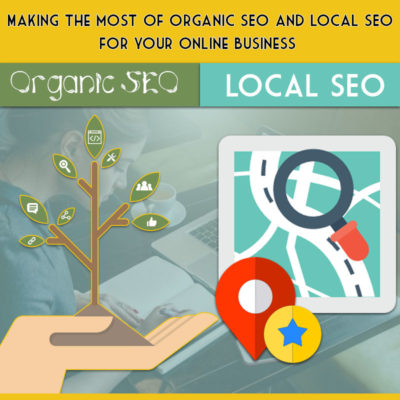
Organic SEO and local SEO for your online businessIrrespective of whether you’re push selling a product or aggressively promoting a service via your web-based or online platform, the effectiveness of your SEO strategy will decide whether your site is there on Google’s or Yahoo’s first SERP. You may be aware that nearly 90% of all users never bother to look beyond the opening search engine results page when looking for a product or service or searching for specific info? So, you might be tempted to ask yourself as to how you can make your e-commerce site claim a 1st page rank on Google, especially after all your previous attempts to do so have come a cropper?
The answer to the aforementioned question largely depends on whether you want your portal to rank for local SEO or organic SEO. There’s a great deal of difference between the two expressions and there are specific factors or attributes based on which organic search engine optimization can be differentiated from local SEO. This article elucidates on the fundamentals of both online marketing strategies, and after going through both, you’ll have a fair idea on where and how to channelize your efforts for driving maximum traffic to your site.

Demystifying local SEO

  • What is local SEO?- When you plan your campaign for promoting your business throughout the world of web based on where you are physically located, such an approach is termed local SEO.
  • Who stands to benefit the most from local SEO?-If you’ve have a brick-and-mortar outlet, physical consultant office or a medical chamber, you’ll stand to gain maximum by fine-tuning your canvassing strategy for local search. In that manner, prospective customers situated in the vicinity of your physical storefront will be able to locate your store or chamber, thereby boosting your business.
  • Modus operandi of local SEO-Consider a hypothetical scenario where you go online and browse for a standard family restaurant in the area where you reside. You’ll most probably search on the Google or Chrome browser using the keywords, ‘best family restaurant in Piccadilly’, family restaurants in Piccadilly’ or ‘restaurants for dining with family in Piccadilly’, and so on. After keying in the keywords, and clicking ‘enter’, you’ll instantly see Google throw up the search results.
  • What you actually see is the first page of the results. The URL at the top of this page is the one that is maximally optimized for searching locally. The URLs that follow are ranked in order of their optimization level. The restaurant heading the list is the one that’d be most convenient for you to step in.

Tips on making the most of local SEO

  • Ascertain your NAP consistency-No ‘NAP’ is not an abstract term but the abbreviation simply stands for name, address, and phone number. When you host your site, ensure that your business’s name, address, and phone no. is identical throughout the internet and across all directories.
  • Take advantage of Google My Business tool-For ranking high enough on local SEO search listings, tap the potential of Google My Business tool for listing as much info about your venture as you can.
  • Persuade customers to post positive feedbacks about your business
  • Always use relevant keywords that will let your customers find you quickly

About organic SEO

  • Defining organic SEO-When Google ranks your website (using search algorithms) based on your site’s content and user-friendliness, the process is called organic SEO.
  • For whom organic SEO is meant?-Organic SEO strategy works best for businesses and firms that only have an online presence and do not own a physical office or branch.
  • Mode of operation of organic SEO-Extrapolating the abovementioned example of ‘family restaurant’, the chances of your restaurant showing up in most organic search results will be higher if you temper content with relevant organic keywords that have a greater likelihood of being used by diners.

Guidelines for taking advantage of organic SEO

  • Keyword optimization is the key
  • Adjust and tweak on-page optimization
  • Garner as many quality inbound links as you can
  • Develop content around a focus keyword

https://www.localseojacksonville.biz will help you out with formulating a customized local or organic SEO strategy for you. You can also make a call to 904.425.9679 for clarifications.